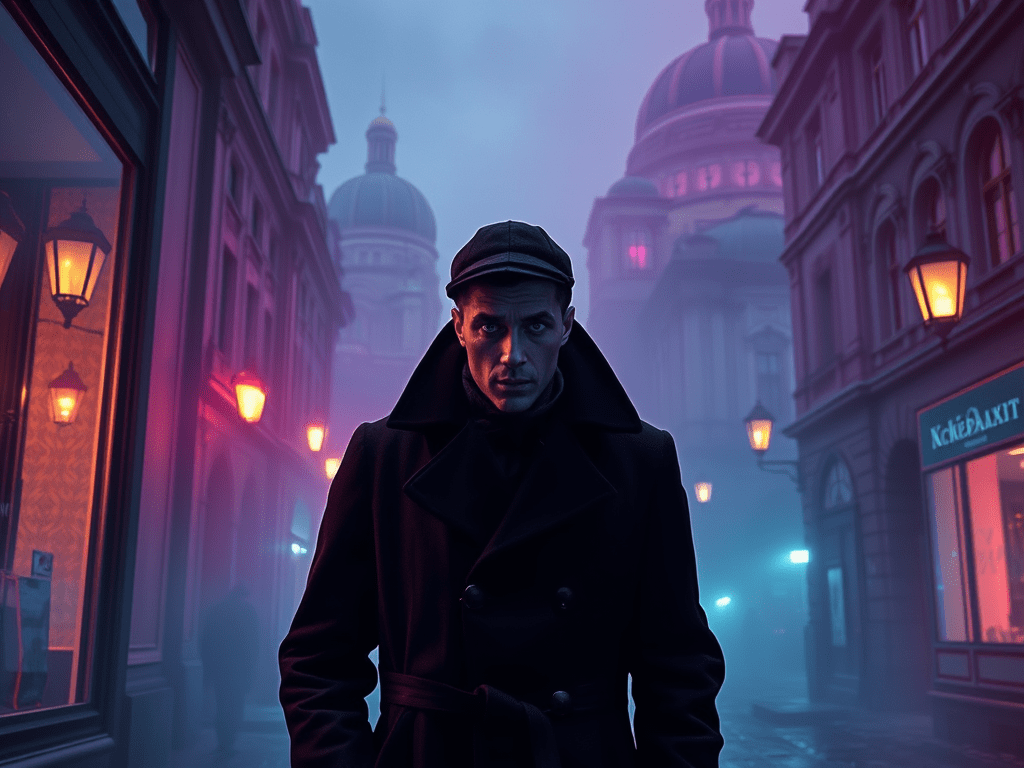
The day after my failed attempt to awaken the Petersburg node, I felt a change in the air. It was more than the cold, damp chill of a St. Petersburg autumn; it was a subtle, almost imperceptible hum that seemed to vibrate in the very bones of the city. The gas lamps that flickered on the street corners seemed to react to my presence, their flames dancing erratically as I walked past. They were like cheap, mechanical imitations of a living light, and my body, a flawed but functioning conductor of the true energy, disturbed their pathetic, oil-fueled dance. I began to notice the strange things that had been there all along, but had gone unseen by a world that had forgotten how to look.
I am a ghost in a ghost city, walking among the ruins of a forgotten world that has been meticulously rebranded as “new.” The immense, ornate domes atop the old buildings aren’t just for show. They are receivers, silent antennas drinking in the ambient aether, even now. The spires, which the official histories claim were purely for decoration, are transmitters, subtly resonating with a frequency that only I, perhaps, can feel. My own body, lean and wiry from a life of subterranean existence, felt like a tuning fork, humming in disharmony with the coarse, industrial world around me.
It’s still here, I thought, my heart a frantic drum against my ribs. It’s all still here, just beneath the surface. And I’m a ghost in it, a last relic of a forgotten age, a living testament to a truth they have tried to bury not just in the mud, but in the minds of men.
I clutched my worn, dark wool greatcoat tighter around my shoulders. It was a costume, a piece of mundane armor designed to make me as unremarkable as the new people who now walked my ancestral streets. My boots, thick-soled and scuffed, were for the mud and rubble of the buried city, not the clean cobblestones of this new world. I looked in a shop window and saw a reflection of a man in his mid-twenties with a pale, drawn face, his sharp, piercing blue eyes carrying the weight of a century of secrets. I saw a man out of time, a living contradiction. The image was a stark reminder of my isolation, of the chasm that lay between me and everyone else. They saw a tired, unremarkable man; I saw a walking tombstone, a silent monument to a murdered civilization.
The city itself felt like a living creature in a deep, troubled sleep. I looked at the new, imposing factories being built at the edge of the city, at the endless railway lines that snaked like metal tentacles across the land, and felt a burning resentment. These were the monuments of the new masters, built on the bones of the old. Men like Dmitri Ivanovich Orlov, the town’s voyevoda, a man who had made his fortune in the very telegraph wires that had replaced the aether. Dmitri was the governor appointed by the ruling family Romanovs, who were themselves little more than puppets to the new world order’s financial elites. These newcomers weren’t just rebuilding the city; they were remaking the world in their own crude, industrial image. My greatest fear wasn’t just that they had forgotten the Tartarians, but that they had co-opted our very essence for their own dark purposes, turning our beautiful, clean energy into a weapon of control.
Again, I clutched my coat, my paranoia a tangible weight on my shoulders. Although I didn’t see any on the streets now, I knew the patrols were around—watching. They weren’t just soldiers, they were the Okhrana—the new regime’s secret police, a name whispered in hushed tones even in the hidden corners of the city. I had heard the stories from others who had gone ‘underground’—stories of friends who had been taken in the night, never to be seen again, simply for speaking of the old world. I am a living repository of that forbidden knowledge, a walking, breathing book they would burn if they found me.
They don’t know about me, I assured myself, the phrase a hollow mantra. If they did, I’d already be dead. Or worse.
I hurried on—to my right was the Neva River, now thick with fog; it mirrored a sky the color of lead, a grim canvas for a lost world. All around me, the grand, neoclassical facades of the buildings were pockmarked with a century of neglect and the grime of industrial soot. Yet, to me, they were magnificent wounds, silent screams of a world that refused to be forgotten. The statues of gods and heroes on the rooftops were not mere carvings; they were part of the network, their outstretched arms and powerful forms once conductors of an energy that flowed as freely as the river itself. But the people of this city only saw cold stone, their purpose erased from collective memory. The lie was so absolute, so all-encompassing, that I sometimes felt my own memories might be a sickness, a solitary delusion.
I soon found myself wandering through a familiar neighborhood, one where my family had lived for generations during The Time Before. But it wasn’t the city of my memory. The old, familiar faces were gone, replaced by new ones. The Great Reset of 1812 had left St. Petersburg a hollowed-out husk, and the Romanovs and their helpers had quickly filled the vacuum by re-populating the city with immigrants. They brought them in on the new, chugging trains—families of settlers from the far-flung reaches of the new Russian empire, displaced peoples from the endless Napoleonic Wars, all with a new history, a new language, and a new way of life. They looked at the grand buildings with simple wonder, and I looked at them with a profound, aching sense of loss. I had become a foreigner in my own home. My own people, once the builders of this magnificent city, were now its ghosts, haunting the very streets they had created.
We survived by becoming invisible, I thought, a familiar ache tightening in my chest. We became the ghosts they told stories about, the ones who haunted the old tunnels and the buried first floors. My grandfather, Andrei Volkov, had taught me the art of being unseen. The Mud Flood had buried the lower levels of the city, but it had also created a sanctuary, a vast, interconnected network of submerged Tartarian living spaces where we could hide from Dmitri’s police force. Like others who’d survived the cataclysm, what was left of my family had retreated into this shadow city. After things calmed down, Tartarians learned to survive by living in plain sight but always out of mind, emerging only to work as artisans, tailors, and repairmen—skilled labor that was useful enough to be tolerated, but not so powerful as to be a threat. It was a life of quiet subservience, a slow surrender of our identity for the chance to simply exist.
I passed a bakery, its warm, yeasty smell a comforting scent in the cold air, but the face behind the counter was new, a burly man who had likely arrived on one of the resettlement trains. I guess they got Anatoly too. I lamented as I quickly trudged towards a small grocery, its front window filled with piles of apples and potatoes. Unfortunately, the grocer was also someone I didn’t recognize, and soon my paranoia began to tighten the coils of my stomach. The faces were changing; the ghosts were being replaced by the living, and the last remaining threads of my old world were fraying.
Surely Arkady is still around. I hurried towards the old tailor’s shop. The old man had known me since I was a boy. Arkady had survived the Great Reset and the subsequent Purge by living as a chameleon. Unlike me, who lived my life as a ghost, Arkady had embraced the new world. He worked with its crude fabrics, stitched new flags for the new regime, and openly praised its “progress.” But in the careful patterns he sewed into his clients’ garments—symbols that only a true Tartarian would recognize—he secretly preserved the old world’s history. He was quickly becoming the last physical link I had to my buried world, a fragile thread to a community that no longer existed. He was a symbol of our tragic, necessary compromise.
As I stepped inside the tailor’s shop, the bell above the door jingled—a sharp, dissonant sound. The place smelled of wool and old linen. Arkady, a man with a face like a roadmap of wrinkles, looked up from his work, his eyes narrowing slightly.
“Nikolai. You look… haunted,” Arkady said, his voice a low rumble.
I forced a small, nervous smile. “Just tired, Arkady. I’ve been working late.”
Arkady put down his needle, his eyes fixed on me. “You’ve been walking the old routes. I’ve heard the whispers. The aether sings when you pass, boy. Be careful. The new masters don’t like the old songs.”
The blood drained from my face. I felt my heart skip a beat. How does he know? I thought frantically. Does everyone know? Am I a fool, a beacon for all the wrong people? The fear, once a distant echo, was now a deafening roar. Arkady’s words were a confirmation of my deepest, most suffocating terror. My very existence was a risk. My connection to the old world was not a secret treasure; it was a mark, a brand, a target on my back.
I mindlessly bought a new pair of gloves, my hands trembling slightly as I paid. I saw Arkady’s eyes linger on my worn coat, and the old man frowned as he noted the fabric of my coat was singed in a small spot from a past experiment, which only further made me feel like a walking target—a man advertising a secret he was desperate to keep.
As I stepped back out into the street, the cold, wet fog seemed to cling to me, a physical manifestation of my fear. I pulled my hat low over my eyes and quickened my pace. I passed a small, public square where a solitary guard, bundled in a thick greatcoat, stood motionless, his silhouette a dark and menacing shape. My heart pounded. I told myself it was just a guard, a part of the city’s landscape, but my mind raced. Is he watching me? Did Arkady’s words betray me? Do they know? But why isn’t he looking at me? The lack of recognition was almost more terrifying than a direct glance. It meant they saw me, but not as a man, just as a thing to be monitored.
I tried to slow my pace and portray nonchalance as I turned down an alley, my boots splashing in a puddle. Risking a glance behind me, I saw the Okhrana hadn’t moved. Good, I thought, trying to calm myself. But as I emerged from the alley, I saw another guard, standing near a horse-drawn carriage. This one seemed to be staring directly at me. My God, I thought, my blood running cold. They’re everywhere. The city is a cage, and I’ve been walking the bars all along.
It took every ounce of my strength not to break into a run as I shuffled along the lonely street—my paranoia now a tangible, living thing on my heels. I weaved through the labyrinthine streets, past silent churches and abandoned warehouses, each building a silent tombstone for a dead civilization. My God, I can feel aetheric resonance here! Yet this knowledge was now a source of terror, not comfort. The old buildings were like a million eyes, watching my every move, their ancient silence a complicity in my potential capture. The very air, which was supposed to be my ally, had become a betrayer.
When I finally reached my workshop, my chest was heaving beneath my coat, my lungs burning with the frigid air. I fumbled with the key, my hands shaking so violently I could barely insert it into the lock. I slipped inside, the thick oak door slamming shut behind me, the sound of the bolt clicking a small, fragile comfort. I’m still safe. For now.
I knew that was a lie. The Okhrana can just as easily get me here as anywhere, I thought as I leaned against the door, sliding down until I was sitting on the cold stone floor. Pulling out the Aetherium sphere from my pocket, I watched its gentle, rhythmic glow—the only light in the pitch-black room. I clutched it to my chest, its warmth a soothing balm against the icy fear as I closed my eyes and began to breathe—slowly, deeply, as my grandfather had taught me. I focused on the hum, not as a source of terror, but as a connection to my purpose. I am not alone. The old world was still with me, a ghost in my blood.
My fear is their weapon, I thought. My fear is a lock on the knowledge I carry.
I sat there for what felt like an hour, allowing the silent song of the aether to calm the frantic beating of my heart. The hum in my hand was a steady, pulsing rhythm now, a heartbeat in the dark, and I felt a sense of clarity growing within me. I’m not a fugitive; I am a custodian. My duty is to protect our knowledge, not for myself, but for my people and even the world. It is a hopeless task, but what else can I do? To do nothing is to let them win completely, to let the lie become the only truth. My life, my freedom, they are insignificant. This is a battle for memory, for a ghost story to one day, maybe a thousand years from now, become a history again. It is for this that I am willing to die.
I thought of my grandfather, a man who had walked this same earth with a secret far heavier than my own. Andrei Volkov had been one of the last true Aetherium Engineers. He had witnessed the Mud Flood firsthand, a cataclysm that didn’t come from the sky but from a calculated, terrible choice of the new world order elites. As a young boy, I had listened, wide-eyed, to the stories my grandfather told in hushed tones, stories of a world that was as alien to my own as a distant star.
His grandfather’s journal was a life’s work, a desperate final act of a dying man. Andrei knew his time was running out. He had taught me to read the old language of the Tartarians, to understand their symbols and schematics. The journal wasn’t just a book of instructions; it was a personal history, filled with Andrei’s lamentations for his lost family, for the world that was, and a stark warning about the new world order. “They will kill even the memory of us,” Andrei had told him on his deathbed, his voice a raspy whisper. “They will rewrite history as they see fit to ‘prove’ we never existed. But they cannot erase the song of the aether. It is in the very air, and it is in your blood, Nikolai.”
Yet after my patriarch passed, and with my mother, father, and brothers also gone, I floundered. Although I’d kept my grandfather’s journal hidden, for a long time I was too afraid to even take it out of its hiding place. The journal thus lay untouched for years after his grandfather’s death, a weight on my soul. I’d tried to be a man of this new, grimy world, to forget the whispers of the past. But I couldn’t. Every time I saw a new factory chimney spew black smoke, every time I saw a news photograph of a new “Gilded Age” marvel with its impossibly ornate facade, I saw the lie. The final push came when I saw a photograph of the newly completed Eiffel Tower from far away Paris. The official story called it an engineering feat, a monument to the new industrial age. That’s when a long-forgotten conversation with my grandfather came back to me – the old man had called it an Aetheric Transmitter, a beautiful, powerful piece of the old grid, and now I realized that it too was being co-opted and rebranded for a new, dark purpose.
I have to try, I’d thought. I cannot let it all be for nothing. And so the decision was made. I sold my few belongings, secured the disused basement, and began the meticulous, lonely work of recreating a single piece of the lost world, fully aware that in doing so, I was signing my own death warrant. My fear was not gone, but it had been eclipsed by a cold, resolute sense of duty.
Still sitting in the doorway of my lonely room, as the last vestiges of my fear receded, a new sensation—quite unexpected—captured my attention. It was a sharp, focused resonance, a discordant note in the symphony of the city that I thought only I heard.
Moving to the window, I scanned the horizon of buildings. It’s coming from the direction of the old library. Someone is trying to connect to the aether. Yet even as I pondered the mystery I realized the sound wasn’t the gentle hum of the old world, but a forceful, almost violent attempt to harness a power. They don’t know what they’re doing! It was clumsy, brutish, and filled with a raw, desperate hunger for power. My heart sank. This wasn’t a fellow ghost; it was a hungry parasite, another new master trying to steal what was left of the old world’s soul.
But then, a sudden, sharp pain lanced through my skull, as if an invisible needle had been thrust into my mind. It was a sensation I had never felt before, a piercing psychic shriek that momentarily overwhelmed the aetheric song. I realized, with a jolt of terror, that this was not a person—it was a… consciousness, and one that was just as linked to the aether as I was, but in a completely different way. It’s desperate, chaotic, but… powerful! It was the mind of something new, something twisted by the very process it was attempting.
I held the sphere tighter, my knuckles white as I moved back inside my flat. Yet the humming returned, stronger now, a clear and urgent message. It was a pull, an undeniable force, telling me to go to the library.
It’s time I stopped hiding in the ruins, I thought. I knew these were not the words of a hero, but of a man resigned to his fate. If they’re calling me, then I’ll go. My life is a small price to pay. For the legacy of Tartaria is the only thing that matters. Even if my final act is to be a footnote in a history that will never be told, at least I will have tried.
 The Apocrypha of Azazel