Part IV: The Pawn of Prophecy
Chapter 3: The Royal Balkery
“Praise be to Rhokki, the maker of stone and water…” Mirkir chanted, then rang the gong again, as the Mining Day service continued to drag on.
“…And to Kalypzo, our mother, the giver of life.” The crowd replied.
[Kalypzo was the Drokka’s name for Gaia – in their religion she served the role of Goddess of Fertility].
While countless animals were slaughtered, the opening prayers to honor the gods continued — for even though this day was about Ajax, the Drokka were wary of offending the gods without giving them their just due first. Yet the ceremony on Mining Day was the longest religious service of the year — spanning multiple candlemarks — and there was plenty of time spent honoring Ajax’s exploits too. For his part Hacktor tried to overcome the awkwardness that came from sitting so close to a father he’d grown so far apart from and instead focused on the prayers.
Hacktor rose and sat, rose and sat, leading the crowd with the necessary replies, yet soon enough he could feel his blood start to boil. This time it wasn’t just the queer vibes that came from Baldur, for Hacktor knew what else was coming — The Readings. As if on cue, Mirkir took a seat — parking himself on a throne-like chair upon a dais facing the crowd.

[Why do high priests always claim to be ‘servants’ to their people, and then sit on thrones like this glorifying themselves?]
Behind Mirkir the altar was raised upon a higher dais and it was here that Mirkir’s underlings bathed in blood as they processed sheep after sheep upon the holy table – the animals’ death rattles a constant cacophony of horror.
For his part, Hacktor had served countless times around that altar and was thus immune to the unsavory aspects associated with the sacrifices. He remembered the first time he had stood by the altar, a young alkolyte tasked with collecting the blood of sacrifices. The warm, sticky fluid running through the ravines into his trembling hands had felt like a rite of passage. Now, the blood was a familiar, almost comforting presence, yet its symbolism was not lost on him – and he longed for it again.
To take his mind away from his yearning, Hacktor instead focused his attention on the sacred dais – the massive structure was sculpted from the darkest obsidian and even when it was covered with blood, Hacktor always felt as if altar pulsed with a living blackness that came from the heart of the giant stone it had been crafted from centuries before. Four ravines were carved into the top of the table, radiating outwards to allow the blood of the sacrifices to flow down into containers that were collected by alkolytes – and Hacktor envied them of their task.

The four corners of the altar were graced with triangular horns of Rhokkium, each nearly a foot high — the gemstones giving off a rainbow of ever-changing colors. Finally, and perhaps most importantly, blazes from The Eternal Flame directly in front of the holy altar ever licked the airs — a constant reminder to the Drokka that the gods were present within this holy hall [although we both know that wasn’t true].
The priests and alkolytes had their faces painted with a mix of charcoal and blood, the color matching their dark robes – all of which were now filthy with soot and ichor. Because of their sacrificial duties the men and boys who served here were in constant motion around the altar — all expect Mirkir. Yet even though the high priest merely sat upon his chair, it was he who stood out the most. With his face covered in a thick white chalk and a fluffy beard as white as snow that reached down to his waist, Mirkir visage marked a stark contrast to the deep sable color of his priestly garments. Mirkir’s robes were the darkest of any of the clergyman around the altar – as befitted his station as The Wyze One — the high priest of the Drokka religion.
[Black robes? Claiming to be wise? Seriously why must everybody steal from me? Perhaps I should take it as a compliment – after all, mimicry is the sincerest form of flattery, right?]
Despite Mirkir’s age — Hacktor knew he had more than eighty winters under his belt — Mirkir was still hale and strong. His grip on my shoulder when I do wrong is like a vice. Hacktor recalled. And the slap he gave me yesterday still stings.
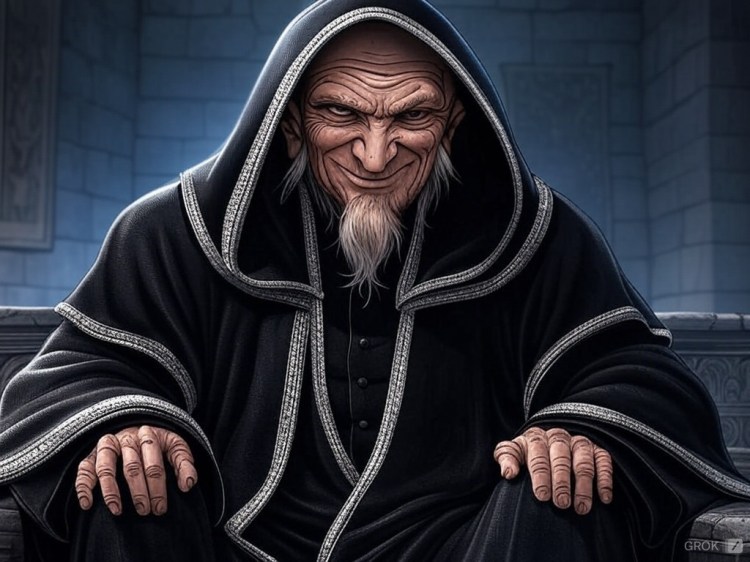
For a moment, Hacktor felt the elderly priest’s eyes upon him — practically boring a hole into him — yet just as quickly the sight was gone, as alkolytes began their slow march around the holy area with censors filled with fragrant incense – quickly shrouding Mirkir, the altar, and everything around him in a murky haze.
From out of these mists a lector began to read from The Nebulungilgalad — that sacred poem by Snorri Sturluson that told the epic History of the Mountains — much of it about the exploits of Ajax and his successful campaign to free the Drokka from the Derkka’s vile grip. While many in the crowd soon found themselves bored by the lector’s drone of a story they’d heard countless times before, Hacktor drank in every word. For Ajax was his hero — and, if truth be told, the historical figure whose legendary feats Hacktor himself hoped to eclipse one day. Such a desire was not as egotistical as it might seem, but instead merely a matter of course — for Hacktor was a Balkery — the first in nearly a century and more importantly the first among the royal family since Ajax, or so said The Kroniklz.
[Hmm, let’s see, Pride? Check. Special Birth? Check? Dissatisfied heir to a royal throne? Check. Are you starting to see why I had such high hopes for Hacktor?]
As a Balkery, under the tutelage of Mirkir, Hacktor had successfully talked with the gods — and the deity who spoke with him was the one that had first told Hacktor about his future greatness. [Can you guess who that was?}
As if being a future Kon-Herr was not enough, Hacktor was born with the Mark of the Balkery. Yet for reasons Hacktor still didn’t understand (or accept), his father Baldur had kept that fact hidden for most of his childhood. Save Baldur, Hacktor’s twin sister Hecla, and Hacktor’s personal valet, none within the Drokka world knew — until one of the high priest’s servants had discovered the truth about Hacktor while posing as a royal valet to the prince — for Mirkir claimed he had always known Hacktor was special and therefore justified his covert operation behind Baldur’s back — much to the king’s displeasure. [OK, it’s possible Mirkir may have been tipped off – but you didn’t hear that from me].
Yet once Hacktor’s secret was out, there was naught Baldur could do to deny it — or more importantly to prevent a then 8-year old Hacktor from being taken away from the palace and raised within the faith by Mirkir and his minions – which was exactly where I wanted him.
Baldur was aghast at losing Hacktor to Mirkir’s clutches. Hecla was distraught at losing her twin. But Mirkir was delighted — and not just because he cared about Hacktor’s soul.
The good news was that Hacktor’s dislocation from court did not interfere with his status as the heir to the throne; in fact his status as a Balkery — a Royal Balkery who had the full power and endorsement of the faith behind him — only strengthened his claim and proactively squelched any power play that may have later come from Bran or any of Hacktor’s other half-siblings when the throne became available.
As the church service dragged on, Hacktor focused his attention again on the readings — the lector continuing the tale of Ajax’s legendary deeds. “And Ajax said to Bashamel, ‘Thus says Rhokki, Lord of the Mountains, ‘The time has come, let my people go that they may serve me.’ Yet with a wave of his hand, Bashumel, Marduk of the Derkka refused. At this the Marduk’s aide addressed Ajax, ‘So let it be written that Bashumel, Grand Marduk of the Dekkka, King of all Gor, and Supreme Ruler of the West has spoken, and these are his words — The Drokka are my people, my property, and so shall they remain. That includes you, Ajax, for you are naught but a puffed up slave. Who are you to speak for a god?’ Yet Ajax would not be dismissed so easily and he warned the Marduk’s court, ‘If you refuse, what happens next is on your head.’ And he stormed out — while the Derkka laughed at his departure…”
They weren’t laughing when Rhokki caused the weevils to destroy their fields, or the reeds to clog their drinking water, or when any of the other perils were cast upon them. Hacktor knew the rest of the story before the lector even read it — yet he also knew that it wasn’t until Ajax unleashed the Hammer of Rhokki that Bashumel supposedly relinquished his grip upon the Drokka. For who can withstand a plague upon the firstborn? Who can withstand the hammer of a god?
[Actually there was a very good scientific explanation for each of the so-called ‘plagues’ that Rhokki allegedly released – I’d tell you that secret, but I don’t want to destroy all your illusions just yet].
“Yet even after Bashumel had agreed to free The Drokka,” the lector continued reading, “even still the Derkka king dealt treacherously with Rhokki’s chosen people — for the Grand Marduk changed his heart and made ready his army to chase the fleeing Drokka and shackle them as slaves again — until Ajax cried out to the Lord to save them…”
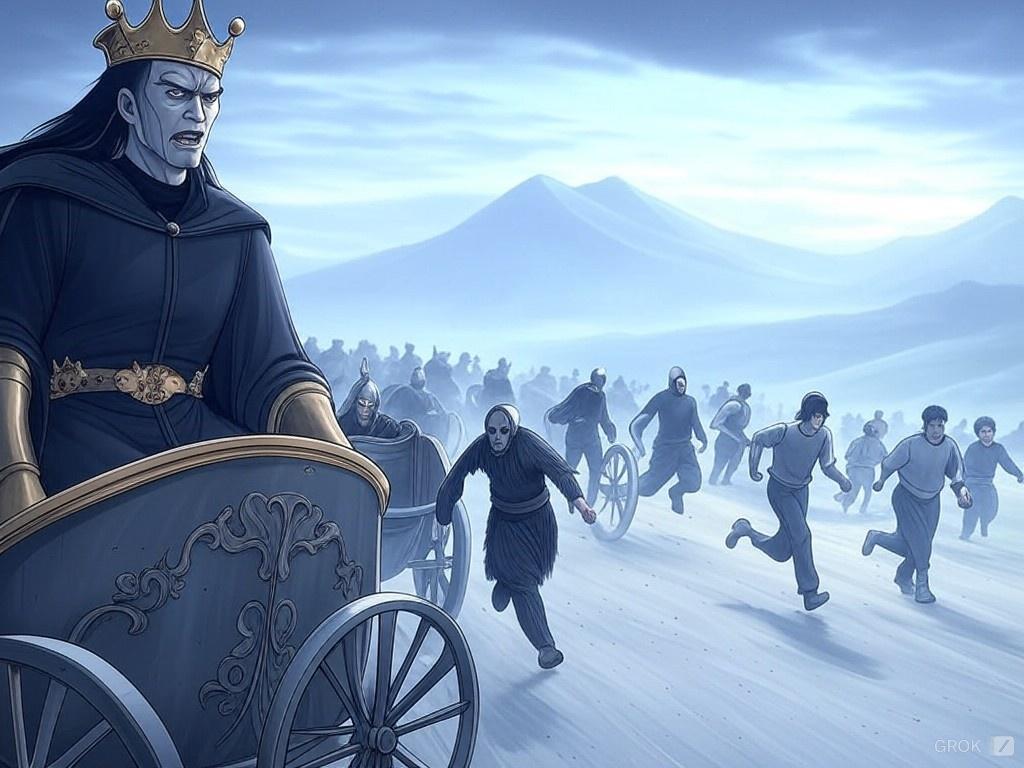
Hacktor’s heart swelled with pride at the story, yet a shadow of doubt crept in as well. The Derkka still controlled The Blackwood, a constant reminder of their lingering oppression and his mouth filled with bile at the thought of his people’s ongoing subjugation.
Arg, even though Ajax won our freedom lo those many years ago where does that leave us now? We might as well still call the Derkka ‘master’ since it is the Marduk and his people who control The Blackwood — and therefore us too. Why can’t my people open their eyes and see that we are still slaves? Hacktor’s mouth filled with bile at the thought.
And while it was true that Hacktor had never been a slave himself, even still he fumed. Yet as the incense thickened and began to mingle with the metallic scent of blood, enveloping the congregation in a hazy fog, Hacktor’s vision blurred. For a moment, he saw himself standing at the altar, a crown upon his head, leading his people to a future free from the Derkka’s yoke.
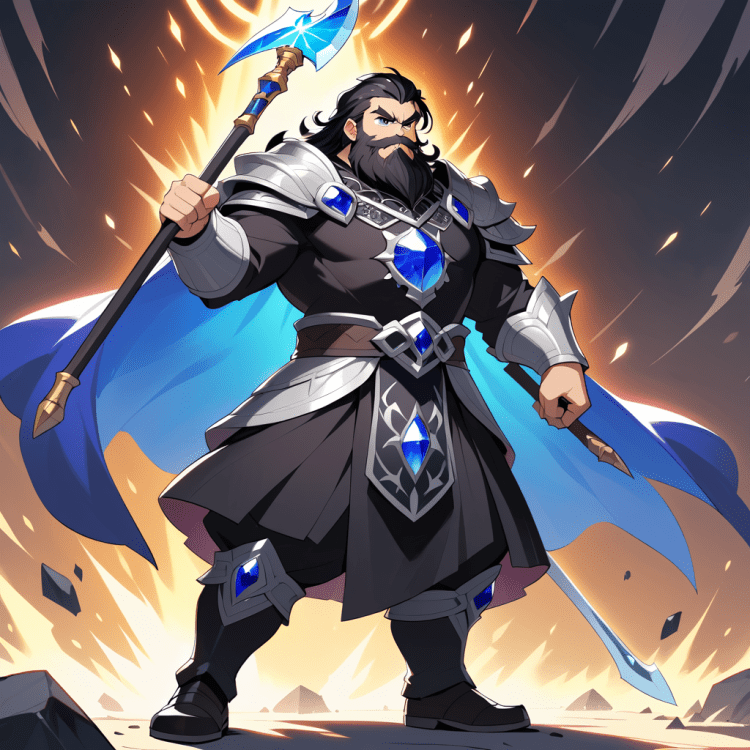
The vision faded as quickly as it had come, yet Hacktor’s mind continued to race. He was more than just a prince; he was a Balkery, marked by the gods for greatness. The weight of his destiny pressed upon him, but so did the desire to surpass Ajax and carve his own legacy. He glanced at Mirkir, whose eyes seemed to pierce through the incense. The high priest’s expression was inscrutable, but Hacktor knew that Mirkir saw the same potential in him—a potential that would either elevate him to legendary status or lead him to ruin.
What Hacktor didn’t know is that I also saw his potential – and like Mirkir, planned to use it to MY advantage.
 The Apocrypha of Azazel