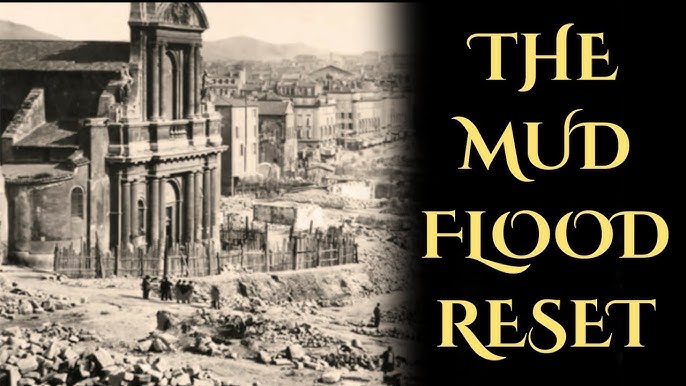
I. The Anomaly That Defies Modern Explanation
From the grand avenues of Paris to the cobblestone streets of Boston, a disturbing architectural pattern emerges: countless 18th and 19th-century buildings have ground floors that are partially—or entirely—buried underground. These aren’t mere basements; they feature ornate windows, doorways, and decorative stonework clearly designed to be at street level, now submerged beneath layers of earth.
The Official Story: Urban planners raised city streets to combat flooding, improve sanitation, or modernize infrastructure.
The Problem: This doesn’t explain why:
- The phenomenon is global (found in cities with no recorded street-raising projects).
- The sediment layers contain mixed-era artifacts (suggesting rapid deposition).
- Many buildings show no signs of structural adaptation (as if the mud came after construction).
II. Case Studies: The Buildings That Shouldn’t Exist
1. The Hermitage Museum, St. Petersburg, Russia
- The Anomaly: The museum’s first-floor windows are partially buried, yet their Baroque detailing suggests they were meant to be visible.
- Mainstream Claim: “The embankment was raised in the 19th century.”
- Mud Flood Counter: Why does the entire city show similar submersion? Why are there no records of a city-wide engineering project of this scale?
2. The Old Federal Building, Chicago, USA
- The Anomaly: Photographs from the 19th century show the building’s ground floor already buried, with arched windows peeking just above the dirt.
- Mainstream Claim: “The street grade was elevated after the Great Chicago Fire.”
- Mud Flood Counter: Why do pre-fire maps show the same submerged architecture? Why are there 1850s reports of “ancient brick vaults” found beneath the city?
3. The “Sunken Cities” of Europe (Paris, Vienna, Prague)
- The Anomaly: Dozens of buildings feature “ghost doors” leading nowhere, filled-in arches, and staircases descending into solid earth.
- Mainstream Claim: “Medieval buildings were repurposed over time.”
- Mud Flood Counter: Why do these “medieval” structures share identical architectural flourishes with buildings in Siberia and North America?
III. Competing Theories (And Why They Fail)
A. The “Raised Streets” Hypothesis
- Claim: Cities intentionally elevated streets to combat disease/flooding.
- Flaws:
- No records of simultaneous global projects.
- Many “submerged” buildings are in arid regions (e.g., Arizona, Crimea).
- Why bury windows but leave upper floors pristine?
B. The “Settling Foundations” Myth
- Claim: Buildings sank naturally over time.
- Flaws:
- Sediment layers are uniform across vast areas (see Moscow’s “cultural layer” disputes).
- Many buried floors show zero structural damage (ruling out slow subsidence).
C. The Mud Flood Explanation
- Evidence:
- Geological: Strange silt layers in city cores (e.g., London’s “Dark Earth”).
- Historical: 19th-century newspapers mention “ancient edifices” dug up during construction.
- Architectural: Star forts, orphanages, and banks all share the same “buried floor” anomaly.
IV. The Smoking Gun: The 1811–1812 New Madrid Earthquakes
- The Event: A series of massive earthquakes struck the central U.S., allegedly causing the Mississippi River to flow backward.
- The Connection:
- Eyewitness accounts describe “fissures vomiting mud” and “whole towns swallowed.”
- Could this have been one localized episode of a global catastrophe?
- After 1812, architectural styles abruptly shift—as if a reset occurred.
V. Conclusion: A Lost Civilization, Buried in Plain Sight
The sheer volume of “buried buildings” cannot be explained by mundane urban development. The evidence points to:
- A Pre-1800s Global Civilization: Advanced builders (Tartaria?) constructed these cities.
- A Cataclysmic Event: A mud-rich disaster (flood? plasma upheaval?) buried the lower floors.
- A Historical Reset: New regimes took over, claiming the buildings as their own.
Next Time You Walk Past a “Basement” Window…
Ask yourself: Was this once a grand entrance? Who walked through these doors—and why were they erased?
Supporting Media Deep Dive
For further “research,” explore:
- Buried Buildings of St. Petersburg (Video)
- Chicago’s Submerged Architecture (Photo Gallery)
- New Madrid Earthquake Eyewitness Accounts (USGS Archive)


