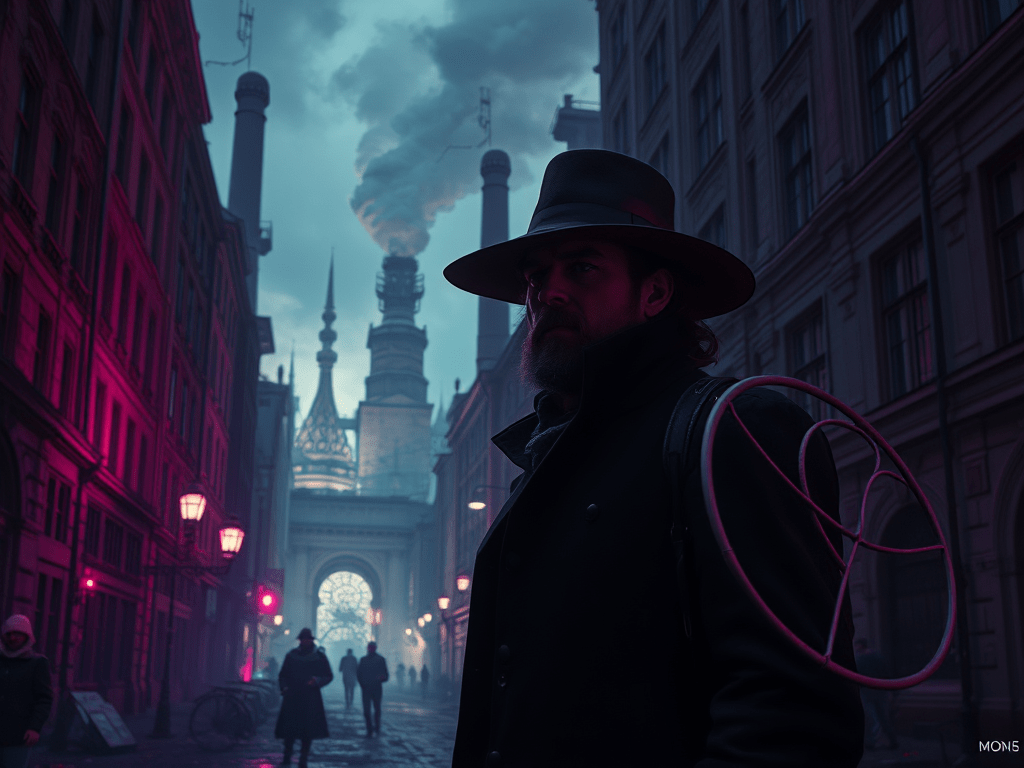
The Echo of the Lost Grid
The year is 1898, and the world hums with the false promise of progress. It is a world I am forced to live in but do not belong to. Smoke belches from a thousand new factories, iron behemoths roar across continents, and a strange, chugging sound—the rhythm of the internal combustion engine—is slowly replacing the silent, ethereal hum of a forgotten age. This new rhythm is a song of oppression, a constant, grating reminder that the world I knew, the world of my people, is dead. In the shadowed alleys of St. Petersburg, beneath the neoclassical facades that once belonged to a grander civilization, I walk with ghosts. I am a ghost.
My name is Nikolai Andreyevich Volkov. I am among the last Tartarians – remnants of a world They erased. I sometimes try to forget the lamentations of my people’s past, but I can’t. The memory of my grandfather’s hushed words, the frantic ink of his secret journal, these and more reminders are branded into my very soul – a constant, nagging ache. They are my burden.
How can I forget what is so painfully obvious to those who know the truth? Your history may speak of the “malfunctions” at the Chicago World’s Fair and the abrupt dismantling of the city’s glorious towers. Malfunctions? I think with a bitter laugh that catches in my throat. As if their delicate, limitless power could ever ‘malfunction’ in the clumsy hands of these grimy usurpers. As my grandfather’s journal harshly reminded me, that these weren’t accidents. They were a systematic purge, a “War on Towers” orchestrated by the very financial titans who were now building their empires on oil and steel. J.P. Morgan and his ilk, the men who would soon fund the new “Standard” of energy, had no use for a world with no meters to read, no fuel for them to sell.
For years, I have been a ghost in my own city, a man living in the ruins of a past I could not speak of. To speak the truth is to invite the attention of the Okhrana, the dreaded enforcers of the New Regime. My grandfather, an Aetherium Engineer in the final days of the Tartarian Empire, left me a single, priceless inheritance: a leather-bound journal and a single, polished sphere of what feels like pure sunlight—a small, humming orb of stabilized Aetherium. The journal was not a history book; it was a manual, a lament, and a terrible, soul-crushing warning. It detailed the principles of the Tartarian energy grid, the flow of aetheric energy through the atmosphere, and the final, brutal days of the Great Reset of 1812.
The journal described a world of abundance and harmony. The Tartarians, or the ‘Ancients’ as my grandfather called them, did not burn coal or pump oil. Their cities, with their impossibly ornate buildings and soaring spires, were magnificent conductors of the earth’s existing energy that continually flowed. In Tartaria, free, limitless energy flowed from the atmosphere, harnessed by every city, into every home, available to every citizen—and the people prospered as a result.
But then came the cataclysm—or, as the journal grimly described it, the “Mud Flood.” It was no accident of nature. It was a weaponized event, a targeted release of a liquified earth slurry, a calculated act of historical erasure. It buried the countless Tartarian buildings, severing the ground-level conduits that connected the architectural conductors. The Tartarian people were hunted down or absorbed—their race ‘cleansed’ from existence by the world’s new masters who rewrote history such that it wiped all traces of Tartaria from the “official” record.
They didn’t just conquer us, I thought, a familiar ache tightening in my chest. They erased us. They made us a ghost story, a myth.
Those world’s usurpers then deliberately plunged the planet into a new dark age, not of ignorance, but of deliberate forgetfulness. During the chaos, the robber barons took control of the Tartarian’s technology—hoarding it for themselves in order to enable them to pillage the planet’s resources and further enrich their class. As for the rest of the world’s population, those who survived were taught a new history: Tartaria was a myth, and all those grand buildings the world over were actually newly built by the industrial philanthropists in the late 19th century. Taking advantage of new technology, photos were published the world over as ‘proof’ of these facts—although I was smart enough to catch the elites’ inconvenient oversight: namely that the sparse groups of impoverished workers who were often shown in the pictures as the builders of these massive modern-day marvels, allegedly did so with mere hand tools and horse-driven carts.
An impossibility, I mused, shaking my head. They couldn’t even grasp the technology they were stealing, yet they expected us to believe they built it with their primitive tools. It’s an insult to the memory of our people…
My mission was simple, yet seemingly impossible: to reactivate a single, small node of the old grid. It was a desperate, doomed act of defiance, a flickering candle in an endless night. My grandfather’s journal held the schematics for a miniature Aetheric Resonator, a device that could be hidden, a device that could tap into the ambient aetheric energy that still lingered in the air, a faint echo of the world that was. I vowed to build a new resonator and then activate it.
The Aetheric Resonator
My workshop was in the basement of a disused library in the city—another Tartarian building, of course, with its first floor a half-story below the current street level. The constant, gnawing fear of discovery was a second skin. Every creak of the floorboards above, every distant siren, felt like a direct threat. I worked by the light of a flickering gas lamp, its weak, yellow glow a testament to the very technology I sought to replace. For months, I had been meticulously crafting the components: a perfect copper coil wound with a single strand of silver, a small quartz crystal I had found in a Siberian riverbed in my youth, and the most crucial element, a tiny, glowing sphere of what I had painstakingly synthesized from the larger sphere.
Tonight was the night. The city above me was silent, asleep in its industrial slumber. I placed the resonator on my workbench, a device no larger than my palm. I attached a thin wire to the tiny Aetherium sphere and placed it in the center of the coil. The journal’s instructions were maddeningly simple: “Connect the resonating core to the nearest star fort anchor.”
My nearest anchor was the Petersburg Fortress. I had spent weeks in its muddy, subterranean tunnels, clearing a small space around one of the immense, star-shaped copper plates that lined its walls. It was a perilous task; the tunnels were unstable, and I had to work in the dead of night, avoiding the city guards who patrolled the surface. My life felt like a perpetual, suffocating act of hiding.
I pulled a small leather bag from my pocket and unwound a 20-foot length of wire. This was no ordinary wire; it was a special alloy, an ancient conductor that could bridge the gap between my small resonator and the massive, dormant node.
I clutched the resonator and the wire, my heart a frantic drum against my ribs. I had to be quick. I snuck out of my workshop, the cool night air a shock to my face. I made my way to a hidden grate in the sidewalk, a forgotten entrance to the underworld of the old city. I slipped through and descended into the darkness.
The air in the tunnel was thick with the smell of damp earth and forgotten time. I moved silently, my boots squelching in the mud. I reached the copper plate, an immense, verdigris-covered slab that hummed with a faint, almost imperceptible energy. I could feel it, a subtle vibration in the tips of my fingers. The old grid was not dead, merely dormant.
I carefully attached the end of the wire to the copper plate and then, with trembling hands, connected the other end to my resonator. For a moment, nothing happened. A sickening dread coiled in my stomach. Is it a fool’s errand? I thought. Is the technology truly lost to me?
But then, a faint, high-pitched whine began to emanate from the resonator. The tiny Aetherium sphere began to glow brighter, its light pulsing in a rhythmic, almost living heartbeat.
My God, I’ve done it! I was amazed as the hum in the copper plate intensified, growing into a deep, resonant chord that reverberated through the very foundation of the city. A faint, almost musical sound filled the tunnel, a sound so ancient and profound that it brought tears to my eyes. It was the song of the aether, the echo of the lost grid, a sound my grandfather had described in the journal, a sound I had thought I would never hear.
I looked up and through a crack in the tunnel ceiling, I saw it. The air above the city, for a brief, glorious moment, shimmered. A faint, silver light, like liquid moonlight, danced between the spires and domes of the old buildings. The gas lamps on the street sputtered and went out, their feeble light no match for the true, living light of the aether. A cat on a nearby rooftop arched its back, its fur standing on end as if charged with static.
The power was not just flowing, it was alive.
The Warning
A voice, not of a man but of a thousand whispers, filled my mind. It was the collective consciousness of the grid, a dormant intelligence that had been sleeping for a century. It was the city itself, waking up.
“Son of the Engineer,” the voice hummed, “the grid is fractured. The ley lines are severed. We are but a ghost.”
My heart pounded. I had made contact with my ancestors—but how?
“I’m sorry,” I whispered back, not sure what to say, my voice hoarse with emotion. “I seek to reconnect it. To bring back our people’s glory.”
“Beware—the usurpers have built their own grid,” the voice continued, its tone a mix of sorrow and ancient rage. “A grid of fire and smoke. It siphons our energy, a parasite on the world’s lifeblood. They have convinced the world this sickness is progress.”
The humming intensified. The Aetherium sphere in my hand pulsed, becoming hot to the touch. The silver light above the city grew brighter, casting the streets in an unearthly glow. The windows of the old buildings, dormant for decades, flickered with an internal, ethereal luminescence.
Suddenly, the voice changed. A new sound entered the aetheric song, a jarring, dissonant chord. It was the sound of a steam engine, amplified and distorted. The sound of an armored train chugging along the tracks, its iron wheels a rhythmic, clanking protest against the silent light.
“They are coming,” the voice warned. “They can sense the resonance. The parasites will not allow the hosts to awaken.”
I looked up in terror. I had been so focused on the technical aspects of my mission that I had forgotten the most important lesson of my grandfather’s journal: the new world order had a vested interest in keeping the old one buried. The “War on Towers” was not just an outdated historical event; it was an ongoing campaign of suppression.
I had to sever the connection, and quickly. I reached for the wire, but a new, more powerful voice entered my mind. It was not the soft hum of the city, but a sharp, metallic screech.
“You are a threat,” the voice of the new regime boomed. “You are attempting to reactivate a forbidden technology. Do not attempt to escape—you will be neutralized.”
The ground above me began to rumble. The sound of heavy boots and a shouted command echoed down the tunnel. They were coming for me!
In a moment of blind panic, I yanked the wire from the copper plate. The high-pitched whine of the resonator immediately ceased. The light in the air above the city vanished, and the gas lamps flickered back to life, their weak, yellow glow an offense to my eyes. The humming of the star fort returned to its imperceptible thrum.
I scrambled back into the darkness, clutching the resonator to my chest. I could hear them now, the heavy breathing of my pursuers, the clanking of their weapons as they navigated the narrow, subterranean passage. My breath was a painful gasp, my heart a frantic, desperate drumbeat. I made it back to my hidden grate, slipping out just as they entered the part of the tunnel I had just vacated—and escaped!
Slipping out of the passages, I melted into the shadows of the city, the cold sweat on my brow a testament to my narrow escape. I had failed to fully awaken the node, but I had succeeded in something more important: I had proven my grandfather’s journal was not a myth. The grid was not dead. It was merely asleep. I knew, with a certainty that had been missing my entire life, that the “Great Reset” was not the end of the story—it was merely the beginning of the great slumber. And I, Nikolai Volkov, the next Aetherium Engineer, was a small, temporary guardian. I was a single voice in a choir of ghosts, a lone flicker of light in an endless night. I knew my fate was sealed. They would find me, eventually. But if I could just connect to the next node, and the next, maybe the song of the aether would echo just long enough for another Tartarian, a ghost like me, to hear it.
My life was a small price to pay. For the legacy of Tartaria was the only thing that mattered.
 The Apocrypha of Azazel