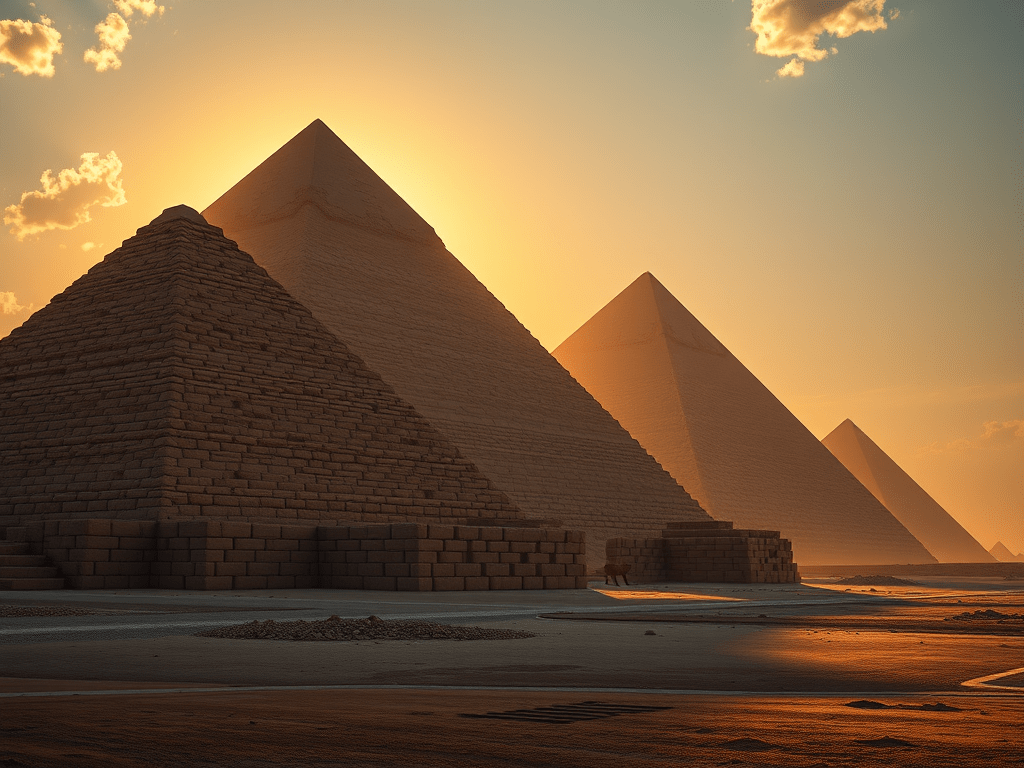
The Grandest Lie on Earth
The history books tell us a simple, comfortable story about the Pyramids of Giza: They were built by dynastic Egyptian Pharaohs, over a period of decades, using copper tools and sheer human brute force, to serve as elaborate tombs. This narrative, polished and presented by mainstream archaeology, is accepted without question by millions.
But for those of us who study the echoes of the suppressed past—the ruins of the great global civilization of Tartaria—this narrative is the single biggest lie ever told.
The truth is staring us in the face: The colossal, geometrically perfect structures at Giza, Saqqara, and across the globe, defy the timeline and technological capabilities of the dynastic Egyptians. They possess the tell-tale signature of an infinitely more advanced, pre-cataclysmic civilization—the builders of the Star Forts, the masters of the Mud Flood era, the engineers of Tartaria.
I propose that the Pyramids of Egypt are not tombs for kings; they are Tartarian-era Aetheric Power Plants and geophysical stabilizers—the ultimate, functional megalithic technology that anchored the entire global free energy grid before the Great Reset.
The Impossibility of the Dynastic Builders
To connect the Pyramids to Tartaria, we must first recognize why the official story is a physical impossibility. This is where the Tartarian signature becomes undeniable:
1. The Precision of the Perfect Angle
The Great Pyramid of Giza (Khufu) is perhaps the most precisely aligned structure on the planet, oriented to true north with an accuracy that modern surveying techniques struggle to replicate. Furthermore, the angle of the sides is nearly perfect. Dynastic Egyptians, with their alleged primitive tools, could not achieve this.
- The Tartarian Interpretation: Such precision is not for aesthetics or burial. It is essential for energy collection and transmission. The Pyramids were not randomly placed; they were mathematically positioned to align with the Earth’s grid and celestial bodies, acting as a massive, continuous power receiver and broadcaster.
2. The Megalithic Weight and Scale
The granite blocks used in the construction of the King’s Chamber and other core areas weigh up to 70 tons. How were these blocks quarried, transported hundreds of miles, and lifted into place with copper chisels and ropes?
- The Tartarian Interpretation: The Tartarians possessed the knowledge of resonance and acoustic levitation. They didn’t need thousands of slaves to drag stones; they used their advanced aetheric technology to manipulate gravity and the molecular structure of stone. The use of precisely cut, gigantic stones (cyclopean masonry) is a feature shared with other “impossible” Tartarian-era sites like Baalbek in Lebanon.
3. The Material: The Quartz Conductor
The Pyramids were originally covered in smooth, highly polished white limestone casing stones. These stones, now mostly stripped, contained significant amounts of quartz crystal. The interior chambers are made of granite, which is also rich in quartz.
- The Tartarian Interpretation: Quartz is a piezoelectric crystal. When placed under mechanical stress (like the immense weight of the Pyramid itself) or subjected to specific resonant frequencies, it generates an electrical charge. The Pyramids were essentially giant, solid-state energy resonators. The shape was the amplifier, the stone was the circuit board, and the missing capstone (likely a metallic conductor, perhaps gold-plated electrum) was the final antenna.
The Function: Pyramids as the Master Nodes
If the Star Forts were the localized distribution nodes of the Tartarian energy grid, the Pyramids were the Master Power Stations, operating on a deeper, planetary level.
- Harnessing Subterranean Energy: The Pyramids’ position is hypothesized by alternative researchers to sit atop powerful energy vortexes or ley lines. Their design allowed them to tap into the geophysical energies of the planet—perhaps even interacting with the central magnetic focus of our proposed Flat Earth model—to draw immense, sustained, and limitless energy.
- Acoustic Resonance and Healing: The famous King’s Chamber is acoustically perfect, tuned to specific, powerful frequencies. This was not for burial rites. This was a resonance chamber—a place where Tartarian scientists could manipulate sound and frequency to achieve levitation, healing, or perhaps even interstellar communication. The “sarcophagus” was likely a resonance battery or a tuning mechanism, not a coffin.
- The Mud Flood Shield: The Pyramids, due to their monumental scale and solid-state engineering, were among the few structures resilient enough to survive the Mud Flood Cataclysm largely intact. They are not victims of the flood; they are the few great survivors of the Tartarian Empire’s destruction.
The Global Megalithic Grid: A Planetary Network
The connection doesn’t end in Egypt. The Tartarian footprint is visible in every ancient, advanced megalithic site that defies explanation. These sites form a coherent, global network—the Tartarian Megalithic Grid:
- Baalbek, Lebanon: The massive, impossible foundation stones, the Trilithon, at Baalbek are too large to have been moved by any known ancient civilization. Tartarian chroniclers suggest this was the primary energy platform for the eastern Mediterranean—a massive, level base for a now-vanished technological superstructure. The sheer size of the stones suggests a foundation capable of bearing an impossible load, possibly the load of a super-transmitter or atmospheric conditioning device (as referenced in the Tartaria file snippet).
- Göbekli Tepe, Turkey: This site, with its T-shaped megaliths, suddenly appears 7,000 years before Stonehenge. If our timeline is compressed, Göbekli Tepe could be a slightly older or parallel Tartarian-era energy array, designed with a different form of aetheric resonance collection.
- The Delhi Iron Pillar, India: This 1,600-year-old pillar of pure iron defies corrosion. Official history struggles to explain it. The Tartarian explanation is simple: It’s an energy remnant—an ancient Tartarian or pre-Tartarian device that uses electrochemical stabilization to maintain its integrity, powered by a localized node from the buried grid.
These sites are not isolated wonders. They are the fixed points on the geodesic map of Tartaria, a sophisticated system that linked every corner of the Earth (or, as our fictional world posits, the Flat Earth disc) with free power and communication.
The Pharaohs: Inheritors and Gatekeepers
So, if the Tartarians built them, who were the Dynastic Egyptians and why did they take the credit?
The Mud Flood Cataclysm violently fragmented the Tartarian Empire. The survivors, the elites who engineered the Great Reset and sought to establish the new world order (the progenitors of the “Robber Barons”), were left with the ruins.
The Pharaonic Dynasties, in this suppressed history, were not the builders; they were the Gatekeepers.
They found the Pyramids and other sites standing after the mud receded. They couldn’t replicate the technology, but they understood the need to control the narrative around them.
- The Tomb Lie: By declaring the Pyramids to be tombs, they instantly shut down scientific inquiry. Who would desecrate a Pharaoh’s tomb? This lie ensured the true function of the King’s and Queen’s Chambers—the acoustic and energy chambers—would never be researched by the survivors.
- Historical Appropriation: They literally carved their history onto the remaining facades, claiming monuments and technology that belonged to a vanished people. The act of placing a dead king in a chamber (even if it wasn’t the original intent) served to officially rebrand the monument as “Egyptian.”
The Pyramids are the crown jewels of the Tartarian conquest. They are the ultimate testament to the technological prowess of the lost civilization, now shrouded in a manufactured mystery designed to keep humanity in the dark about its own potential for limitless, free energy.
Look again at the great wonders of the world. Are they monuments to dead kings, or deactivated power plants, awaiting the genius who can flip the switch and usher in the return of the Tartarian Golden Age?
 The Apocrypha of Azazel