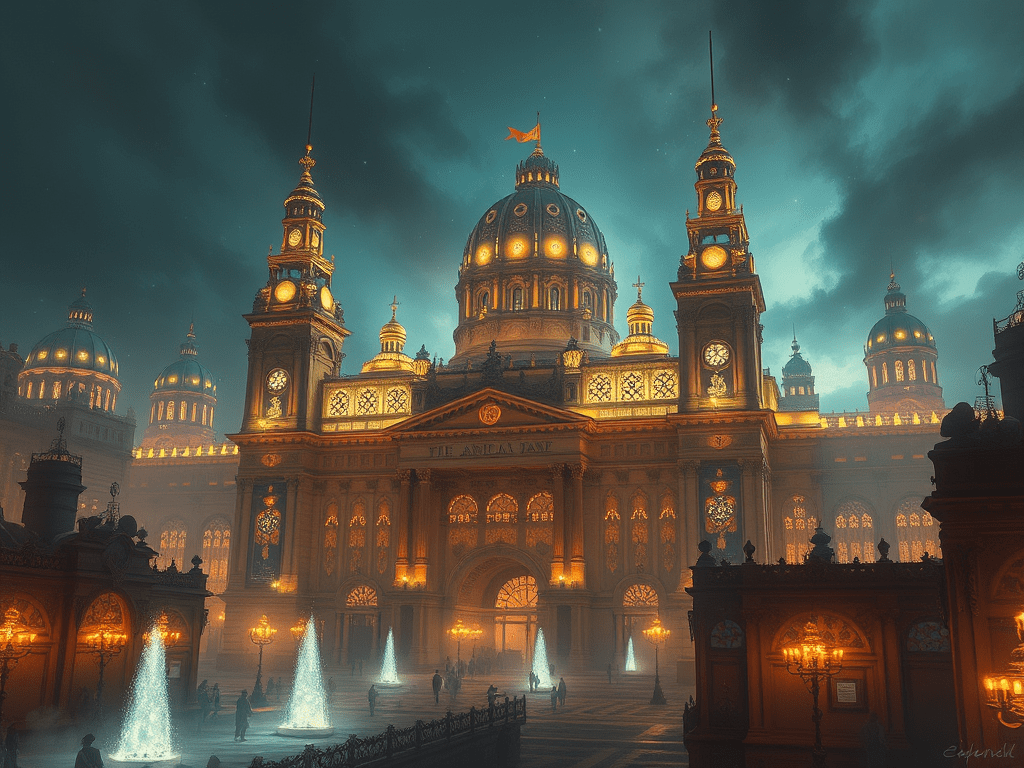
A Celebration or a Cover-Up?
In 1904, the city of St. Louis, Missouri, hosted the Louisiana Purchase Exposition, a spectacle universally known as the 1904 World’s Fair. By all accounts, it was a breathtaking display of progress, technology, and colonial triumph, drawing nearly 20 million visitors and showcasing the burgeoning might of the American Century. It was a monument to the Gilded Age, a dazzling display of electrical illumination, architectural fantasy, and industrial power.
Official history tells us this event was the ultimate celebration of the victory of Edison and Westinghouse—the triumph of metered, alternating current (AC) electricity and the oil-fed combustion engine.
But for those of us who study the suppressed history of the Tartarian Empire, the World’s Fair was not a celebration of new technology; it was the public, spectacular funeral for the old one. It was the final, coordinated act of the Great Reset, a deliberate stage-show designed to distract the global public while the ruling elites—the Morgans, Rockefellers, and Rothschilds—dismantled the last, magnificent remnants of Tartarian free, atmospheric, or “aetheric” power generation.
The 1904 World’s Fair wasn’t about showing the future; it was about burying the past under 1,200 acres of temporary plaster-and-lath construction.
The Colossal Scale: Too Big to Fail, Too Fast to Build
The sheer scale of the 1904 Exposition is the first red flag. It spanned an astonishing 1,240 acres, featuring 1,500 buildings. The Palace of Manufactures alone covered 13 acres. The construction timeline, however, is impossible by conventional accounts.
The official narrative suggests these massive, ornate, Beaux-Arts structures—complete with incredible architectural detail, marble-like facades, and colossal statuary—were erected in a few short years using 19th-century methods. This is a common theme in Tartarian research: the sudden appearance of vast, sophisticated “temporary” architecture.
The Staff and Plaster Lie
The prevailing historical explanation for the rapid construction is the use of “Staff,” a material essentially made of plaster, cement, and hemp fiber, mixed with wood lath and jute.
We are told that entire empires of architecture were quickly fabricated from this flimsy material. While staff was certainly used for decorative elements, the foundation and scale of these pavilions suggest they were built upon or around pre-existing, megalithic Tartarian infrastructure.
- The Theory: The World’s Fair sites—like those in Chicago (1893) and St. Louis (1904)—were deliberately chosen because they were already home to massive, half-buried, Mud Flood-era ruins. The elites did not build the palaces; they exhumed, patched, and temporarily covered the surviving Tartarian buildings with the “Staff” facade, branding them as new American achievements.
- The Hidden Power Cores: The great domes and towers—particularly the Festival Hall and the Cascades that flowed from it—were not just ornamental. Their size, geometric placement, and location at the highest points of the grounds suggest they were the remaining aetheric collection and transmission towers of the old Tartarian grid.
By claiming they were built from temporary plaster, the authorities could justify their eventual, suspiciously swift demolition.
The Grand Deception: Spectacle as Subterfuge
The central element of the 1904 Fair was its dazzling illumination. It was called the “City of Light,” consuming more electricity than the entire city of St. Louis itself. But where did this power truly come from?
While the Fair featured massive Westinghouse dynamos and steam engines, our theory holds that these were merely stage props—a symbolic demonstration of the new, metered energy system that was replacing the free energy.
The Aetheric Power Drain
The Tartarian free-energy system operated based on principles of resonance, atmospheric pressure, and the Earth’s natural magnetic field (often symbolized by the globes and spires atop old buildings). This energy was free, clean, and available to anyone who knew how to tap the system.
The “City of Light” was perhaps powered in two ways:
- Draining the Network: The Fair’s electrical spectacle was used to intentionally overload and burn out the remaining power cores in the Tartarian transmission architecture, ensuring they could never be reactivated. They used the old system to power a massive light show, effectively killing the infrastructure through a dramatic final usage.
- The Cover Story: The huge, inefficient, coal-burning dynamos displayed by Westinghouse were the necessary historical smokescreen. The public saw steam, coal, and massive machines—the future of paid, corporate energy—and were thus conditioned to accept that only complex, proprietary, and costly infrastructure could provide power.
This spectacle was a psychological operation, designed to flip the switch in the public mind from “energy is free” to “energy must be paid for.”
🔨 The Demolition: The Scorch-Earth Policy
The most damning piece of evidence for a cover-up is what happened after the Fair closed on December 1, 1904.
These colossal, architecturally magnificent palaces—which cost millions of dollars and countless hours to build (or refurbish)—were not repurposed, maintained, or sold. They were systematically, and with suspicious haste, demolished.
The official excuse? They were only made of staff and weren’t meant to last.
This is a profound historical anomaly. Imagine tearing down the Eiffel Tower or the Lincoln Memorial months after their completion simply because they were “temporary.” The speed and totality of the destruction defy rational economic or architectural logic.
Erasing the Evidence
This wasn’t simple demolition; it was an act of erasure. The goal was to remove all physical evidence of the Tartarian re-claimed buildings before independent researchers or the displaced “Orphan Train” survivors could identify them as remnants of their heritage.
- The Landfill: The mountains of debris—the staff and the underlying Tartarian megalithic structure—were often dumped into nearby waterways or used as landfill, ensuring that the evidence was thoroughly scattered and buried, adding to the global “Mud Flood” layers.
- The Re-Branding of Parks: Today, the site of the 1904 World’s Fair is Forest Park, a beautiful green space that bears no trace of the civilization-level architecture that stood there. The few surviving structures, like the Saint Louis Art Museum, were preserved only because they were originally built with permanent, non-Staff materials—perhaps because they housed the administrative core of the Great Reset operators themselves.
The rapid destruction served as an undeniable, physical seal on the new timeline.
The Missing Exhibits: Technology the World Never Saw
Beyond the architecture, the true purpose of the Fair was to categorize and suppress certain technological exhibits.
While Tesla was conspicuously absent (having his funding already cut, the Tartarian sympathizer was sidelined), the Fair was replete with displays of “curiosities” and “primitive” technologies from developing nations, many of which may have been repurposed Tartarian devices.
- Ancient Batteries: The Fair featured early demonstrations of battery technology and crude electrical generators. Was this a distraction from the Tartarian system of aetheric power accumulators? Researchers have noted that many ancient artifacts—from decorative pots to geometric stones—resemble early electrical components. Were such artifacts displayed at the Fair, only to be dismissed as mere ceremonial objects before being shipped off to the Smithsonian’s Graveyard for permanent concealment?
- The Ethnographic Annexes: The Fair hosted entire villages of indigenous peoples, often presented as primitive examples of humanity. What if these “villages” were actually strategically placed to isolate pockets of Tartarian cultural survivors—peoples who were still utilizing traditional, local methods of free energy or healing that stemmed from the old civilization? By labeling them as “savage” or “primitive,” their knowledge was simultaneously dismissed and contained.
The Fair was a giant museum of the victorious elite, curating what the world was allowed to remember and what it was forced to forget about how power, both electrical and political, truly operates.
The Legacy: A Blueprint for Control
The 1904 World’s Fair achieved its primary objective: it cemented the belief that energy is a scarce commodity requiring massive corporate infrastructure and centralized control. It visually and physically eliminated the last grand vestiges of the Tartarian system, replacing them with a temporary, spectacular lie that was then demolished to erase the memory.
It was the ultimate propaganda coup: a celebration of progress that was, in reality, a funeral pyre for true human potential. The millions who attended left believing they had witnessed the birth of the future, never realizing they were present at the final burial ceremony of a magnificent, free-energy past. The world walked away from St. Louis having accepted the Great Reset’s fundamental lie: that freedom is not inherent, but must be purchased.
The ruins are gone, the children were scattered, and the electrical grid was rerouted. But the questions remain. We must look at the images of those colossal, ornate, temporary palaces and ask: Why tear down perfection? The answer is simple: Because it wasn’t theirs, and it was the key to freedom they could not allow us to keep.
 The Apocrypha of Azazel