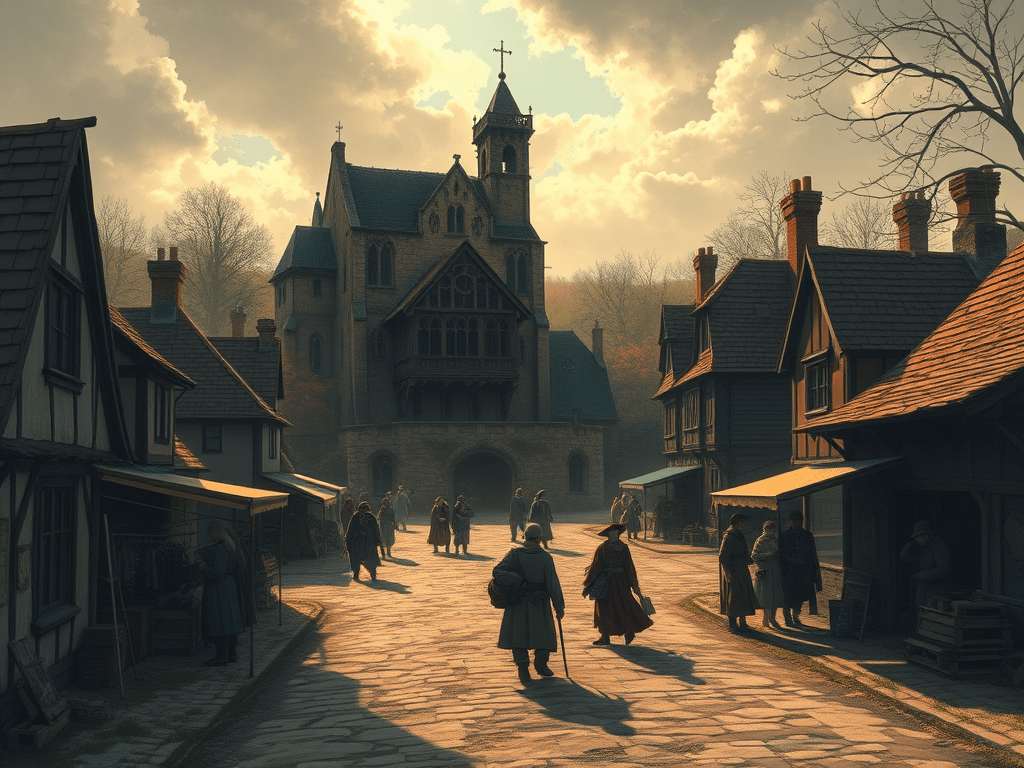
Location: Monthaven
Timeline: Sixth Age, Year 52, Early Spring
Monthaven—the pathetic, sequestered farming village that was Emcorae’s home town. It was a smudge on the northern Pennal landscape, forgotten by time and spared the glorious chaos of growth and collapse. If not for the endless supply of lumber and the uncommonly rich soil that fed its small-minded residents, the place would never have existed at all. It was founded two or three centuries prior to our story, its only purpose being to extract mundane profit from the earth.
The entire settlement spanned a mere five miles, mostly farmland, intersected by four unpaved roads that met at the Market Square. This square was the key location of the villagers’ sad lives – like in most other human cities of this Sixth Age of Substance, religion held a strong sway over the people in this town. In the case of Monthaven – that religion was the worship of Mannah [the supposed savior ‘son’ of Yah-Way] and that faith was on display in the town’s church.
By appearance alone, there was no doubt that the Church of Mannah was the very center of life in Monthaven. The rectory itself was THE geographic hub of Market Square and not a single function took place in the city that the church did not sponsor, organize or in some way play a part — even if only to offer its permission or blessing to allow the event to occur.
The Tyrants of the Tabernacle
Like other man-made religions, the primary purpose of the Mannah Faith seemed to revolve around generating donations from the peasants who lived in the far-flung churches of the faith’s empire and sending that income to the Primcitta Cathedral where the Mannah Elders ruled from. For most of it’s history, Monthaven’s peoples’ ‘fair share’ failed to live up to the Prelator’s expecations. This was a problem – for when the smaller chapels didn’t send in enough donations, it had a negative trickle-up effect to the higher levels of the faith. And yet, no matter who the Prelator in Primcitta had sent to Monthaven, the townsfolk never paid them much mind. It wasn’t until the exasperated Prelator of a century past sent Pastor Petrus Manning to Monthaven that things finally changed in the church’s favor.
And for six decades, Petrus Manning transformed the town and solidified the Mannah Faith in Monthaven. A small man whose shock of hair had turned strikingly white at an early age, Pastor Manning had always seemed to appear older than he really was, yet I’ll give him credit – the man had a knack for dealing with people and doing the ‘soft skill’ work that all the prior long-tassel wearing pastors only ever paid lip service too.
Manning was also the first cleric in Monthaven who took an active role in the town meetings – eventually being offered a leadership role by the townsfolk – he accepted on the grounds that he would be the spiritual advisor but declined to be the sole figurehead. Yet Manning soon wielded power from behind the scenes – ingeniously planting his ideas into the minds of the town elders and shaping Monthaven’s future, all the while blessing the secular decisions with Yahway’s approval.
The country bumpkins loved Manning – and with donations flowing to Primcitta, even Prelator was happy. However, a man’s life is never long, and Manning’s eventually began to wind down. When he was nearing his eighth decade, the Prelater sent an assistant to Monthaven – Alfransis Kastelli.
Young Alfransis’s time in Monthaven was supposed to be short – relieving the old cleric of some of his duties, until a more permanent replacement could be found. After that, the young cleric was marked for advancement – some even said he might end up as a Prelator himself one day.
Upon Manning’s death, Kastelli suppressed the villagers’ mourning – calling excessive grief a sin against Yahway and his son Mannah. [There’s that word again “sin” – ione of my greatest inventions! If you don’t know the story, read it again here.] To distract the people, the new pastor commissioned the building of a magnificent wooden cathedral – a supposed monument to Mannah.
Rather than accept a quick replacement, Kastelli stalled Primcitta’s leadership with a request to remain in Monthaven until the new cathedral could be completed – promising the Prelator that the donations would flow like never before. That church took a decade to build – during which time Kastelli allowed himself to become a forgotten man in the Mannah’s Faith’s hierarchy. As it turned out, Kastelli – a man whose spirit was as big and boisterous as his massive physical frame, realized he rather enjoyed being a self-satisfied big fish in a stagnant, small pond. He had no desire for the political games of the bigger cities, instead he simply wished to dominate his own domain.
And dominate he did.
During his time, Kastelli reorganized the town’s monthly bazaars, soon requiring a tithe from all vendors in exchange for Mannah’s “blessing.” By promising salvation, he also convinced numerous farmers to bequeath their property to the church upon their death (and often before it), thus expanding the church’s land holdings.
[It was an obvious grift – and a beautiful one. After getting those farms, Kastelli’s church began its own farming operations – selling their produce at the local bazaars and swelling the coffers. And while Kastelli’s tomatoes weren’t as red, ripe and juicy as the ones from Old Man Newberri, or the corn as sweet the Pryde farm’s, Kastelli’s produce had a distinct advantage – his crops were blessed! Naturally then, his faithful followers bought all of the church’s product first at the market days — appeasing the ever-watchful spiritual leader as he walked the bazaar and kept track of where every coin went. Kastelli thus padded own building renovations slush fund and also sent plenty of coin back to Primcitta – to the delight of the Prelator. Year after year Kastelli exceeded expectations and year after year transfer offers came in from the Council Elders – yet Kastelli rejected them all. Eventually the Primcitta leadership gave up and let Kastelli “waste” his talents in that forgotten sleepy little locale. It’s not often I witness someone give up prestige for happiness– which is why so many of you people are so unhappy.]
Kastelli also transformed local government. The Town Council— then comprised of the local solicitor Hin Perballi, the farmer Old Man Newberri, the cobbler’s wife Sandi Frixer, and the church healer Ben Wirtz—was by now utterly subservient. Kastelli made no illusions about his authority, enforcing his will without qualm.
[Given his massive size, fiery attitude, and larger than life personality, none of the poor villagers were equipped to challenge Kastelli’s rule – therefore he ruled unfettered. He stood well over six feet tall and easily weighed more than twenty stones. With a deep rumbling voice, steel gray hair, and hard piercing eyes, he had an intimidating physical presence, with a huge chest atop a massive pair of tree trunk legs].
The big priest lived to eat. His massive oak dinner board was typically overflowing with eggs, pies, roasted chickens, and jams. He refused to listen to anyone—even the church healer, Doc Wirtz—who suggested his massive weight was the cause of his ever-aching back.
“That food is my holy sustenance,” Kastelli once bellowed. “And I need to feed myself to keep my energy up so’s I can keep trying to turn Monthaven into a god-fearing town, worthy of serving Mannah.”
The Sermon of Subservience
And so it was that on a beautiful spring day, Pastor Kastelli was delivering another roaring sermon, his voice echoing over the faithful. His message was simple: money and obedience. He warned his parishioners about the perils their souls would face should they fail to give their time and money to their church, using the usual, tired phrases: “it’s the Lord’s will,” and “Mannah needs your help.”
“If any of you have trouble figuring out what your fair share is,” he advised, “then see me after mass—and it wouldn’t hurt to bring a pie or two to help me think.”
The congregation laughed, but Kastelli then offered a new, vital warning. He pounded his hands on his pulpit, condemning the heresies of foreign traders. “Pan? Rhokii? Mesmer-something? Poppycock, I tell you! These false gods do not exist!”
[I’ve heard this blasphemy, of course. My amusement at his sheer ignorance was vast. The fool denied the very Chaos that made his existence possible].
Kastelli then spotted Emcorae Azop in the crowd—and seized the opportunity for self-aggrandizement.
“You remember the demon that once almost stole away one of our own—the beast that tried to take Emcorae Azop? But did the demon get him? No. In fact, Emcorae is here with us again today!”
He pointed to Emcorae, the young man predictably blushing at the unwarranted spotlight.
“Yes, friends, I saved him because of his faith… If you are not a Believer, or you know someone who is not—woe to them—for I cannot help them… There is only one evil god—Baal. Fear him, yes. And his minions. But take comfort in this: there are three good powers that are watching over us. Meree our loving mother. Mannah the son of God. And of course, Yahway Himself, our father. Belief in them will save your soul.”
[Talk about rewriting history – if I recall correctly Kastelli was hiding out in his bedroom while Alfranco Azop saved Emcorae, but what do I know?]
He concluded his pathetic monologue: “Pray. And show me that you believe by donating to our chapel fund so that I can put them to Mannah’s holy uses.”
The sermon concluded not out of spiritual necessity, but because the overweight clergyman suddenly realized how hungry he was. I’ve got to remember not to talk so long.
His eyes immediately searched the crowd, settling on Pallina Azop, Emcorae’s grandmother. My devoted Paulina, she always drinks in every word of my message, I love that woman! He salivated at the thought of her cooking, the Gnokkis or Gulunkis he imagined she had prepared for her returning grandson. His stomach emitted a rather loud grumble.
The remainder of the service was completed in double time, the priest unable to control the urges of his stomach to go any slower. The spiritual needs of the flock were easily defeated by the Pastor’s need for his next hearty meal.
Such is the depth of mortal faith, eh?
 The Apocrypha of Azazel